Mexico extends from the U.S. border to Guatemala and Belize, between the Pacific, the Gulf of Mexico and the Caribbean. The Baja California Peninsula projects south on the Pacific side, while the Yucatán Peninsula faces the Gulf and Caribbean. The central highlands include Mexico City, the national capital, and extend toward cities and valleys whose temperatures and settlement patterns can feel entirely different from those at sea level. The country is easier to understand as several distinct landscapes than as a single stretch of coast and an inland capital. Visit Mexico’s destination directory
Mexico suits visitors who want a city, a region with a historical focus or a settled stay where ordinary food, streets and daily routines are part of the interest. The trade-offs vary with the kind of travel. A week based in a central district of Mexico City has less in common with a week on the Yucatán Peninsula than a national description suggests. A Mexico City and Oaxaca trip can be manageable with a deliberate transfer. Trying to add widely separated coasts changes the number of good days at each end.
Pick a cluster first, then ask how much of the week you want to spend moving. For a city trip, heat, elevation, air quality and actual station or airport transfers can have more effect on the first day than distance on a map. For a month, kitchen access and a local radius that works with your schedule are important. Choose a specific address only after comparing routine food and medical access for both the stay and the season.
See the North America overview. On the map, the Pacific, Gulf, Baja California and the Yucatán Peninsula establish the broad orientation. The city markers are starting points for local research.
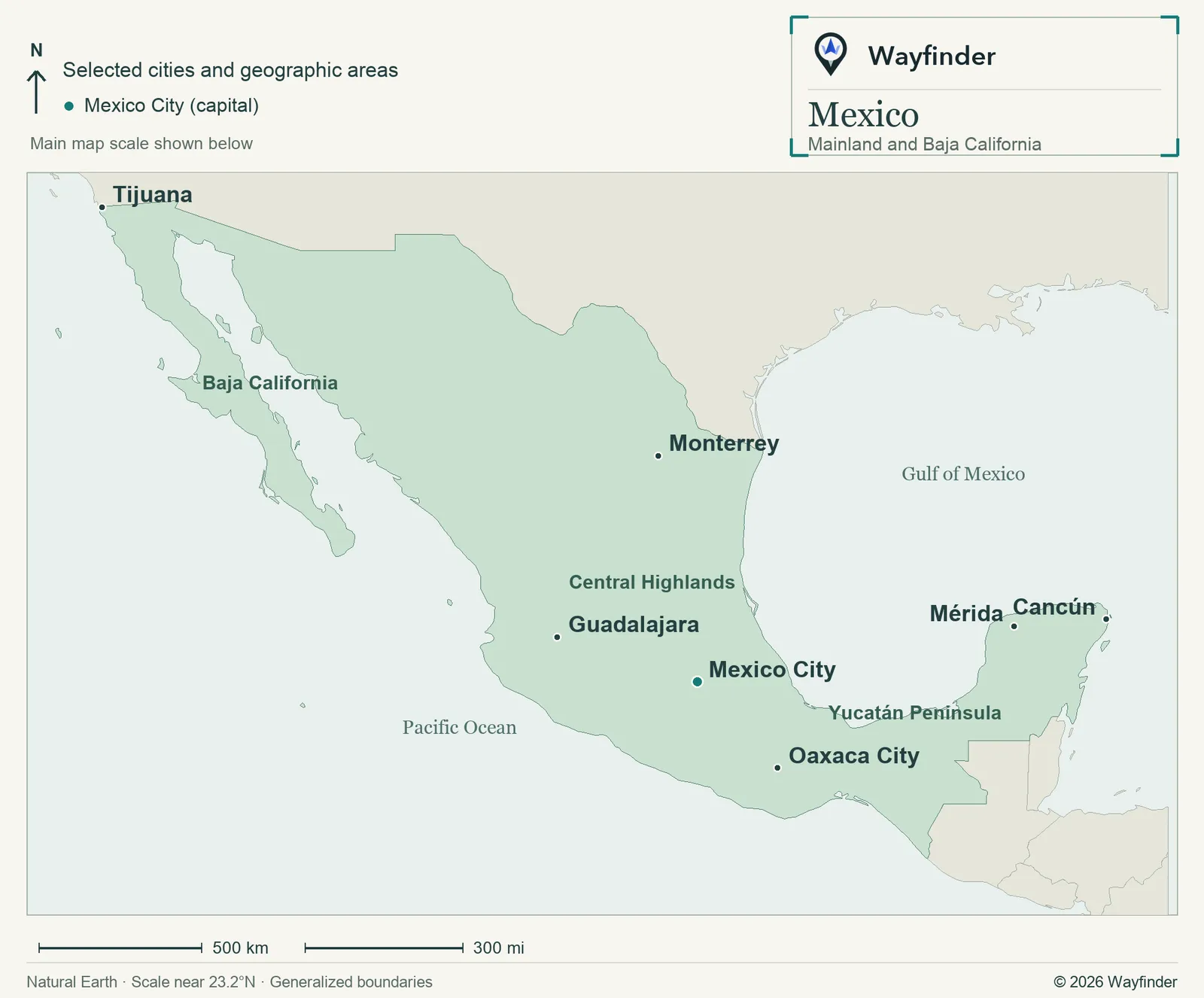
Open the full-detail orientation map

Regions and settlement
The regions here are editorial choices. Mexico’s states and Mexico City have administrative boundaries. The destinations used by tourism organizations may be narrower than these groups, and a label such as the Central Highlands describes geography rather than a jurisdiction. For a changeable rule or advisory, look up the specific state, route and municipality.
Mexico City and the central highlands. The capital’s districts form part of a large metropolitan area. Puebla and the cities of the central interior add other historical and economic perspectives. A day or two in the center can give an introduction, but it is not the same as getting to know the whole metropolis. Start by identifying the travel radius around your chosen district and the few places you expect to visit repeatedly. Allow time to adapt your pace at elevation, especially if the trip has just begun.
The west, Bajío and Pacific coast. Guadalajara offers a western urban base. Historic towns and industrial centers of the Bajío make a distinct inland cluster. The Pacific coast contains destinations farther apart than a single regional name suggests. A city stay can make sense even if an ocean trip comes later, provided the move has a purpose. In a coastal neighborhood, check the actual climate, travel network and ordinary food and shopping options outside the peak dates you see advertised.
Oaxaca and the southern highlands. Oaxaca City provides one way to understand the region’s urban and valley geography. The coast of the same state needs a separate transport and seasonal assessment. Chiapas has its own regional history and a mix of upland and lowland settings. Do not infer the conditions on a mountain or border-region road from one city experience. Decide whether most of the week is about the central valleys, a particular coast or another setting. Choose the correct location before choosing the airport or bus.
Yucatán Peninsula and Gulf Coast. Mérida, Campeche and Cancún give very different introductions to the peninsula. The coast and the interior also have different practical situations. If the interest is an ordinary city stay, test the neighborhood before depending on a series of trips elsewhere. A stay at a coastal resort may offer straightforward services while requiring extra planning for independent journeys. The wider Gulf includes places beyond the peninsula, such as parts of Veracruz and Tabasco. Confirm the local conditions rather than taking a regional reputation as evidence.
Northern Mexico and Baja California. Monterrey is one city-centered starting point for the north. The border communities, deserts, mountain areas and long Baja California Peninsula raise different questions. An urban arrival is not a guarantee about the land route to another town or across a border. Plan the part of the country you mean to see and use route-specific official advice. If an alternative means another long road or air leg, know how you would arrange it before leaving the main services behind.
INEGI’s 2020 Population and Housing Census counted 126,014,024 people. This is a census benchmark, with a clearly defined date and scope, rather than a current population estimate. National totals encompass the high density of Mexico City, the populations of large urban areas such as Guadalajara and Monterrey, and many smaller settlements across widely different environments. Consider the metropolitan area separately from its central jurisdiction when making comparisons about size. INEGI 2020 census results
The pattern of settlement matters to how a neighborhood functions. A small address change in an urban area can make a different bus or rail corridor useful, or add a long last walk. In a valley or coastal town, you may need to go farther for appointments, large shops or transportation to another region even if the immediate neighborhood serves everyday meals. Do not compare a city and a rural stay as if their only difference were room price.
History through places
Teotihuacan, Monte Albán and the Maya sites of the southeast offer distinct accounts of cities, authority and the organization of space. Teotihuacan’s history is separate from later political developments in the Valley of Mexico. Monte Albán has its own context in the Oaxaca valleys. In the Maya landscapes, dates and relationships among places matter. Chichén Itzá, Palenque and Calakmul are useful starting points for questions about different sites and periods. Mexico’s Indigenous peoples are communities of the present. The purposes of an archaeological property and the rights and interests of a living community should each be understood on their own terms. UNESCO Mexico list
The Historic Centre of Mexico City and Xochimilco inscription links the capital to the former lake landscape and the transformations of settlement over time. Puebla’s historic center represents a different location and a distinct colonial city. In Oaxaca, UNESCO links the historic center with the archaeological site of Monte Albán through one inscription. That grouping does not collapse their chronology or establish physical proximity in the way a first-time traveler might imagine. Find out what each component helps explain and consider it within its own landscape. UNESCO Mexico list
Guanajuato and Zacatecas contribute to the history of mining and urban development. The Camino Real de Tierra Adentro points to links among towns and institutions over a much larger distance. As other purposes came to the fore, these routes could continue to shape which places were connected and where work took place. A building’s importance can lie in how it related to an industry or local community, not only in formal design. UNESCO Mexico list
The central campus of the National Autonomous University of Mexico and the Luis Barragán House and Studio bring twentieth-century institutions and architectural practice into view. A modern city also shows histories that are not collected in a list of protected properties. Work, housing and public space help explain how neighborhoods grew and why people move between them. On a short stay, give one subject enough time to follow it beyond a single landmark. On a longer one, notice what ties the onetime outskirts or a former industrial area to the current city. UNESCO Mexico list
Climate and choosing dates
The Servicio Meteorológico Nacional provides climatological normals and station charts for the 1991–2020 reference period. Examine the exact location and station rather than comparing a highland city to a coast through one national average. Elevation, latitude and exposure to different bodies of water make the seasonal patterns distinct. The table is a planning summary. Recent forecasts and warnings govern the conditions of the trip. SMN climate normals
| Area | Warmer or wetter months | Cooler or drier months | Practical check |
|---|---|---|---|
| Mexico City and central highlands | Warmer spells and summer rain can affect outdoor hours | Cooler nights, especially away from the lowest elevations | Compare the city’s altitude and temperature pattern with accommodation comfort |
| Oaxaca valleys and southern uplands | Summer rain and local mountain conditions | Drier periods can still have cool highland nights | Verify road, valley and coastal forecasts separately |
| Pacific and Gulf coasts | Heat, humidity and tropical weather may matter | Patterns vary between coasts and latitudes | Check the specific region and marine warnings |
| Yucatán Peninsula | Heat and rain shape the hours you can be outdoors | Milder stretches can still be humid or rainy in some places | Examine shade and hourly recovery options |
| North and Baja California | Desert and inland heat can dominate a visit | Cold nights or mountain conditions remain possible | Check the station nearest the exact terrain |
Use the season to decide how much moving is realistic. For a valley location and a sea-level base, pack and choose travel hours separately. A city itinerary can move activities into the earlier and later parts of a hot day, while a longer road or boat leg may be far less flexible. If a trip depends on a route through exposed ground or along a storm-prone coast, plan a useful alternative within the region rather than making a second distant booking.
For a month, imagine a specific day when conditions are inconvenient. Ask what the room feels like in the afternoon, which local routes are shaded or sheltered and how much of a normal routine is possible. If rain limits use of an outdoor space, get details about indoor ventilation and room layout. If the accommodation is farther from a food shop or pickup point, test what it means in heat and heavy rain. Normal weather is a reference for these practical questions, not an assurance for any particular date.
Economy and everyday infrastructure
INEGI publishes Mexico’s quarterly GDP estimates, both seasonally adjusted and by activity. In its February 23, 2026 release, INEGI reported that real GDP rose 0.9% in the fourth quarter of 2025 from the previous quarter, on a seasonally adjusted basis. Check the latest release for the current figure, and note whether it compares one quarter with the previous one or with a full year. The releases report primary, secondary and tertiary activities separately, useful for seeing the relationship among agriculture, industry and services rather than interpreting the economy only through visitor spending. INEGI GDP statistics · INEGI February 23, 2026 release
Industrial activity and services help shape the northern border and main city regions. Agriculture and trade also matter in places a visitor might first see through food or a change in landscape. Port cities and central urban areas have working functions in addition to being arrival points. Give some time to understanding the routes that support everyday life, including what the largest services are and why they sit where they do. An old town can be part of an active regional economy, even when the spaces most visible to travelers are associated with earlier history.
Planning infrastructure begins at the accommodation address. Ask whether reliable water, ventilation and the type of internet access you need are available at the unit. Confirm how the host handles deliveries, access and maintenance. A room advertised as near a major district may still be awkward for late journeys or daytime heat on the sidewalks. Use a specific map, consider your route after dark and see how you would make important journeys if your first choice becomes inconvenient.
The useful radius for a month can differ from the one for a week. A short trip might justify an address chosen solely around arrival and the places you want to understand. Four weeks make grocery access, laundry and quiet space more consequential. If a location depends on a hired vehicle for every trip, include that reliance in the cost and time comparison. A viable small-town stay may still be attractive when a single nearby district provides what a traveler needs most days.
Language culture and etiquette
Spanish is the broadest practical language for visitor arrangements. Mexico also has many distinct Indigenous languages, which are associated with different communities and contemporary lives. A national language label does not tell you what support is available at a specific office or health provider. English may be easier to arrange with some large-city or resort tourism businesses. Confirm it separately with whoever will handle a lease, appointment or formal paperwork. INEGI on linguistic and cultural diversity
Keep names and addresses in Spanish and use locally preferred names where relevant. A written address and nearby landmark can help when a street name is repeated. Learn how to ask a person to clarify a number, a direction or an appointment in plain terms. For a document with financial or legal consequences, use suitably qualified help. For a medical issue, ask the facility how any interpretation would be arranged rather than assuming your accommodation can provide it.
Greet people in shops and when asking for help. At a community event, ceremony, workshop or place of worship, ask before photographing people or deciding that a visitor can enter. Taking time to understand where guests can go and what is private is especially important where a site serves both residents and travelers. Follow local directions about where to wait and how to use shared facilities. A polite exchange is usually more useful than assumptions about what is normal across Mexico.
If a dietary restriction affects where you can eat, prepare an accurate question in Spanish and ask the provider about the actual food and how it is prepared. Ask about the bill when the payment arrangement is unclear. Avoid planning to negotiate or take photos where the enterprise has its own rules. In markets and on public transport, leave room for people doing regular work or going about their day.
Budget and payments
Budget in Mexican pesos. Check which forms of payment a business can accept. Carry a practical backup and review the currency and amount at the point of payment. For a longer rental, confirm deposits, utilities and mandatory charges with the party taking payment. Someone who uses different ways to pay an airport transfer, a small shop and a larger hotel should plan each separately. Banco de México on circulating currency
This illustrative comparison as of November 21, 2026 uses an invented private-room and household budget for one adult. It assumes seven paid nights or a separate 28-night agreement, with local transport and everyday expenses.
| Item | Seven nights | Twenty-eight nights |
|---|---|---|
| Room at MX$1,350 per night or a separate MX$24,000 quote | MX$9,450 | MX$24,000 |
| Food and household costs at MX$520 or MX$400 per day | MX$3,640 | MX$11,200 |
| Local transport at MX$165 or MX$120 per day | MX$1,155 | MX$3,360 |
| Laundry and incidental allowance | MX$1,050 | MX$2,600 |
| Illustrative total | MX$15,295 | MX$41,160 |
Flights, intercity fares, admissions, insurance and any refundable deposits are outside the figures. Use actual quotes for your city, date and intended location. Compare staying with the same practical network with moving to lower-priced accommodation farther away. Daily ground transfers or a room with limited equipment can offset some accommodation savings. It is also worth budgeting for the occasional arranged journey if transport at night or during heavy rain is a constraint.
Arrival and internal transport
The best arrival is the one that works for the initial region and transfer. Mexico City, Cancún, Guadalajara and Monterrey are different starting positions. In a metropolitan area, confirm the exact airport and the location of the accommodation rather than relying on a city name. A long ground move after a late arrival can be a worse choice than a night near the gateway. Verify the planned transfer with the carrier or provider, including where you meet it and how you would change it if the first leg is late.
As checked November 21, 2026, the UK FCDO entry guidance applies to people traveling on a full British citizen passport from the UK. Other travelers should ask Mexico’s consular or immigration authorities for the requirements applying to their passports and purpose. Check the intended land, air or sea arrival and any transit countries. A visitor can have a different situation from someone taking up residence or work. Start with the Mexican consular service responsible for your circumstances. FCDO entry requirements · Mexican consular visitor visa guidance
| Example | Compare | What to check |
|---|---|---|
| Mexico City to Oaxaca City | Scheduled coach or domestic flight | Exact bus station or airport, transfer time at both ends and arrangements after arrival |
| Mexico City and Puebla | A single city base with a chosen trip or separate nights in each | Time at the desired part of each city and where the service stops |
| Mérida and a coastal or archaeological destination | Use suitable verified public or arranged transport, or spend nights nearby | The approach, late return and heat while waiting |
| Northern or Baja California destinations | Compare regional flight, coach and road as available | Exact state and route, daylight, current advice and emergency alternatives |
ADO has an official Mexico City–Oaxaca coach page. Confirm which terminal is appropriate for the actual departure rather than assuming the nearest terminal serves it. On a longer planned road journey, check circumstances for the corridor and the place at the end. Compare the usefulness of a car against parking, road conditions and the amount of driving you actually want to do. ADO Mexico City–Oaxaca
Safety health and access
The UK Foreign, Commonwealth & Development Office’s Mexico guidance for British travelers was checked November 21, 2026. It uses state and route distinctions. Use its current regional-risk page and the instructions from the government that serves your citizenship. An advisory may separate a state, specified districts and some routes within it. Do not transfer guidance from a familiar city or organized trip to a different road. Keep environmental issues such as hurricanes, heat and flooding separate from the questions about crime and route security. FCDO regional risks for Mexico
For British travelers, consult the FCDO’s health page about preparation and local availability of care. U.S. travelers should review their own government’s and insurer’s information. Compare the healthcare and language arrangements available at the actual destination, and think separately about urgent transport. A city facility may be appropriate for a routine appointment while a particular kind of emergency calls for different arrangements. Ask your clinician about concerns involving altitude, heat or underlying conditions. FCDO health guidance
Practical access needs the exact location. Ask which entrance you can reach, the surface and slope between the street and room and the arrangements on the service you plan to take. Outdoor routes can involve heat exposure or rough surfaces even if the nominal distance is modest. When a plan depends on an accessible transfer or a particular condition, recheck it directly before departure.
Heritage and nature
UNESCO’s Mexico list encompasses archaeological sites, historic cities, industry and routes, and natural environments. Sian Ka’an, the Monarch Butterfly Biosphere Reserve and the islands and protected areas of the Gulf of California illustrate different settings and kinds of stewardship. A listed landscape can include separated areas and different authorities. Check the current arrangements for the precise location before deciding how it fits into a trip. UNESCO World Heritage list for Mexico
- Agave Landscape and Ancient Industrial Facilities of Tequila (2006)
- Aqueduct of Padre Tembleque Hydraulic System (2015)
- Archaeological Monuments Zone of Xochicalco (1999)
- Archaeological Zone of Paquimé, Casas Grandes (1998)
- Camino Real de Tierra Adentro (2010)
- Central University City Campus of the Universidad Nacional Autónoma de México (UNAM) (2007)
- Earliest 16th-Century Monasteries on the Slopes of Popocatepetl (1994, 2021)
- El Tajin, Pre-Hispanic City (1992)
- Franciscan Missions in the Sierra Gorda of Querétaro (2003)
- Historic Centre of Mexico City and Xochimilco (1987)
- Historic Centre of Morelia (1991)
- Historic Centre of Oaxaca and Archaeological Site of Monte Albán (1987)
- Historic Centre of Puebla (1987)
- Historic Centre of Zacatecas (1993)
- Historic Fortified Town of Campeche (1999)
- Historic Monuments Zone of Querétaro (1996)
- Historic Monuments Zone of Tlacotalpan (1998)
- Historic Town of Guanajuato and Adjacent Mines (1988)
- Hospicio Cabañas, Guadalajara (1997)
- Luis Barragán House and Studio (2004)
- Pre-Hispanic City and National Park of Palenque (1987)
- Pre-Hispanic City of Chichen-Itza (1988)
- Pre-Hispanic City of Teotihuacan (1987)
- Pre-Hispanic Town of Uxmal (1996)
- Prehistoric Caves of Yagul and Mitla in the Central Valley of Oaxaca (2010)
- Protective town of San Miguel and the Sanctuary of Jesús Nazareno de Atotonilco (2008)
- Rock Paintings of the Sierra de San Francisco (1993)
- Wixárika Route through Sacred Sites to Wirikuta (Tatehuarí Huajuyé) (2025)
- Archipiélago de Revillagigedo (2016)
- El Pinacate and Gran Desierto de Altar Biosphere Reserve (2013)
- Islands and Protected Areas of the Gulf of California (2005)
- Monarch Butterfly Biosphere Reserve (2008)
- Sian Ka’an (1987)
- Whale Sanctuary of El Vizcaino (1993)
- Ancient Maya City and Protected Tropical Forests of Calakmul, Campeche (2002, 2014)
- Tehuacán-Cuicatlán Valley: originary habitat of Mesoamerica (2018)
Choose a base for a week or a month
| Base | An ordinary week | An ordinary month | Check first |
|---|---|---|---|
| Mexico City | Learn a few districts and leave time for a flexible city day | Choose a local radius before adding many cross-city trips | Altitude, air conditions, route to services and noise |
| Oaxaca City | Focus on the city and one suitable regional contrast | Try ordinary shopping and a regular neighborhood schedule | Difference between valley and coastal conditions and access |
| Guadalajara | Stay in the city and choose one western regional outing | Compare a central booking with a place on your everyday routes | Actual time between neighborhoods and municipal service locations |
| Mérida | Use a city base with selected outward journeys | Test how the indoor and outdoor routine works in heat | Ventilation, shade and reliable local transport |
| Monterrey | Get to know the particular city and nearby setting you want | Choose the workaday urban radius before considering long journeys | The practical distance from the room to the services you will use |
For a few days, a city can provide a complete first visit. A week suits one base and an occasional alternative, or two places with enough nights around each transfer. Two weeks can be devoted to the capital and a separate highland or coastal region. If the interest is primarily archaeological or nature-focused, select the places first and verify how to reach each from a practical overnight location. Several sites in a broad area can make one good regional trip without making one good day.
A month offers time to see how the place works on ordinary weekdays and weekends. Use the first week to set up a few routines and test assumptions about transport and weather. Keep some commitments flexible until you know whether the apartment, local shopping and ordinary language expectations are a fit. Distinguish the place that drew your interest from the place that makes a useful base. In some cases the stay is richer if they are the same. In others, being able to spend several days in a well-chosen neighborhood makes visits farther out more enjoyable.
Try a highland and lowland comparison
If both Mexico City and the Yucatán appeal, define a different purpose in each. A first journey might use Mexico City for an urban and historical introduction and settle into one lowland base for a separate part of the trip. The transfer should have time assigned to it, along with an initial day that can be adjusted to the new conditions. It is worth knowing whether the accommodation is near services you will use if you decide to rest instead of spending your second day in transit again.
If the main interest is Oaxaca, spend time identifying which part of the state matters most. In the valley, regular food and lodging decisions may be naturally centered on the city. A coastal week asks different questions about heat, access and movement. Putting both on the same itinerary increases travel commitments. If a quieter stay is what you want, let the second part have enough time to find a sustainable routine. A regional journey works when the difference between the two settings was part of the plan all along.
Compare an ordinary day before committing
For a week in the capital, select a neighborhood and make the first day’s geography gentle. Decide which journeys can wait until after you have rested and navigated a short local trip. If your room is in an area with many services, you can have a satisfying day there without building in another long cross-city transfer. That also helps reveal whether the location might suit a longer stay. Try an afternoon that includes a real errand and some unstructured time rather than only a planned visit.
A Guadalajara or Monterrey stay has different outward directions and may not use the same arrangements after dark. Check how a trip to a necessary address works from the neighborhood you mean to use, including whether the address sits in a separate municipality. For a coastal location, aim for one route you like using and an indoor arrangement that makes rest days enjoyable. The closer fit of an everyday routine should be part of the comparison alongside the appeal of an occasional outing.
If traveling as a pair, choose a base where one person can stay nearby while the other takes a longer outing. This is especially valuable when people have different tolerance for altitude, heat or long road travel. Verify the transfer for the person going farther and make sure the other person’s useful daily radius does not depend on the same vehicle. A less ambitious plan can make the trade-off easier to live with.
Longer stays and retirement
A trial stay can clarify whether climate, language and services fit your needs. Legal residence requires a separate determination. U.S. citizens considering it should consult the appropriate Mexican consulate about current options and required evidence for their circumstances. Questions about healthcare, insurance, tax and obligations at home also deserve their own review. For practical preparation, use RESTED’s longer-stay guide. FCDO entry requirements and links to Mexican authorities
Explore the existing Global Guide visitor guides
Central highlands
Southern highlands
For things to do, browse Bucketlist Experiences.
Official sources checked November 21, 2026.
Explore within Mexico
Map of Mexico
Hold Ctrl (or ⌘) and scroll to zoom, or use + and −
Mexico
3 guides · 5 experiences
- Mexico City 1 guide · 3 experiences
- Oaxaca City 1 guide · 1 experience
- Teotitlán del Valle 1 experience
Pins mark the town or main visitor area of each place and are approximate.