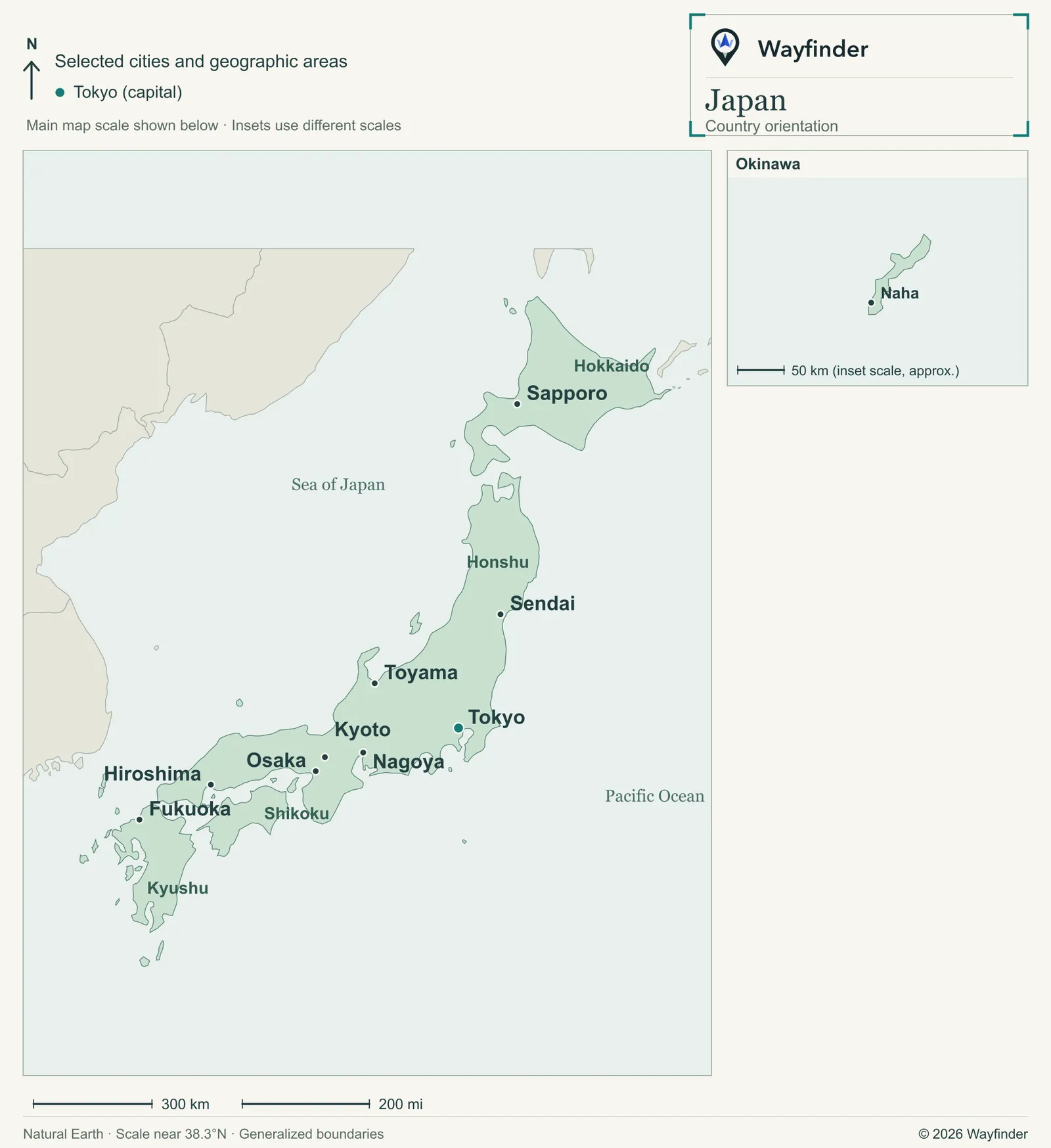
Japan’s main islands extend from Hokkaido in the north through Honshu, Shikoku and Kyushu. The islands continue southwest toward Okinawa. Mountains, narrow stretches of usable coastal land and a long north-to-south reach shape where cities have grown and how visitors move among them. Tokyo is the capital. The other cities in this guide offer different starting points, from Sapporo and Sendai in the north to Fukuoka in Kyushu and Naha in Okinawa. Japan National Tourism Organization destination directory
Japan can suit a first city visit, a trip that follows a major rail corridor or a much slower stay centered on one neighborhood. Its transport strengths matter most when the desired places line up with useful services. They matter less when the actual destination is a mountain community, a small island or a place with an infrequent last connection. The distance between two cities is only part of the decision. Choose the routes you want to rely on and look carefully at where they end.
Travelers who enjoy moving around without a car can start with a major city. Those with strong interests in landscape, architecture or a specific region should consider giving that region most of the available time. A ten-day trip with many arrivals can feel less revealing than a week in one city and several distinct days in another. Month-long travelers should pay particular attention to the unit itself, the local language and how much ordinary time will be spent at either end of a transit journey.
See the Asia overview for broader geographic context. This map shows the four main islands with a separate Okinawa inset. It identifies selected cities and the Sea of Japan and Pacific Ocean.
Open the full-detail orientation map

Regions and settlement
The following regions are an editorial framework. The prefectures are administrative units. Tourism offices and operators may group them differently, and broad islands and seas are geographic areas of yet another kind. Use the prefecture or municipality when looking for an official instruction about the exact place. JNTO destination directory
Hokkaido and Tohoku. Hokkaido has its own climatic and historical context. Sapporo gives it a metropolitan base. The northern part of Honshu, often described as Tohoku, includes large cities, farming areas, uplands and coastal communities. Sendai offers one metropolitan starting point. A trip centered on Hokkaido and one centered on northern Honshu are different trips, even in the same season. Compare useful connection days, accommodation and the hours of daylight you need before adding both.
A shorter trip can be built around one city’s normal routine and a modest change of scenery. A longer one can spend time in a smaller town, but only if the ordinary provisions and the arrival arrangements work. Save the local name in Japanese and note whether the destination is the station, town or a separate settlement with the same name on a route map. In winter, ask whether your luggage and walking plans still work in snow.
Kanto and Tokyo. Tokyo sits within a broad metropolitan area. A Tokyo address could serve a short urban visit or become a unit you return to every night for a month. Before settling on a district, choose the few recurring lines and local services you want to use. If one partner wants a different daily schedule, test how both plans work from the same address. An accommodation labeled convenient can suit one station and require an awkward change to another.
Central Honshu. The central part of Honshu includes the Pacific-facing urban and industrial belt around Nagoya, mountain areas, and Sea of Japan-facing landscapes that include Toyama and the wider Hokuriku area. These environments differ in weather and the direction of their useful routes. The topography makes it unwise to assume that two places with close latitudes or a similar distance from Tokyo offer a simple connection. Check a corridor and the final local leg before trying to use one place as a base for everything.
Kansai and western Honshu. Kyoto and Osaka are useful in different ways. Compare the districts where you would actually live and which direction you intend to travel afterward. Hiroshima brings western Honshu and a different stretch of the inland sea into the picture. A familiar city pair in the guidebooks does not obligate you to move rooms between the places. Choose how much time the commute would take away from the parts of the day you value.
Shikoku, Kyushu and Okinawa. Shikoku is a separate island with inland and coastal settings. Fukuoka is one way into Kyushu, but the northern city should not stand in for the whole island. Farther southwest, Okinawa is a useful distinction for climate, history and transport. Naha and a more remote island have fundamentally different connections. The island leg needs attention of its own, including how you would replace it if conditions change. A traveler looking for a settled stay should compare the facilities within a daily radius before assuming a small island would make the easiest base.
Japan’s Statistics Bureau estimated a national population of 123.802 million on October 1, 2024. Tokyo Prefecture made up 11.5% of the national total, and the five most populous prefectures accounted for 37.9%. Those are administrative counts and do not describe the full boundaries of the respective metropolitan areas. The same national total includes many communities where neighborhood and intercity transport work on a much smaller scale. A traveler choosing a base should distinguish national concentration from the day-to-day usefulness of one station or town center. Statistics Bureau population estimates
History through places
The Jomon prehistoric sites of northern Japan point toward communities that long predate the institutions of the later state. The Kofun group at Mozu and Furuichi reflects a different period and form of social organization. Prehistoric settlement sites and monumental tombs preserve different kinds of evidence. On a map the areas are far apart, but the point of linking them is to compare how knowledge about early societies is grounded in the material record. UNESCO Japan list
Nara and the Horyu-ji area put courts, religion and exchange with continental Asia into the story. Kyoto represents later histories of government, religion and urban development. The property called Historic Monuments of Ancient Kyoto includes components in more than one modern municipality. Treat its collection of places as a historical grouping. Looking up one address or station does not tell you where the others are, and no one visit needs to encompass the entire designation. UNESCO Japan list
Himeji’s castle provides a different historical starting point, while the villages of Shirakawa-go and Gokayama show adaptation to a rural and snowy environment. The islands to the southwest have a history connected to the Ryukyu Kingdom and to seaborne trade and exchange. Their place in Japan is easier to understand when approached through the geography of the islands and their neighbors. The Ryukyu properties recognized by UNESCO speak to a specific historical setting rather than an extension of the story of one mainland court. UNESCO Japan list
Modern industrial history appears in the Meiji industrial sites and the silk industry at Tomioka. These are contexts in which ports, industrial sites, sources of energy and working settlements became connected across large distances. In Hiroshima, the Peace Memorial is connected to the atomic bombing and its memory. Visitors interested in the period should leave room for the museum and institutional interpretations that address people as well as buildings and dates. UNESCO Japan list
These places give very different views of the country. To deepen a short visit, choose one thread and ask how it appears in the city or landscape where you will be. A conversation about urban settlement, industrial movement or religious life is more coherent than a list whose only common feature is World Heritage status. Modern Japan is also visible in the ways cities organize work, shopping, suburban travel and public space today.
Climate and choosing dates
Japan Meteorological Agency observatory normals cover 1991–2020. The table uses January and August monthly mean air temperatures from four stations to show how large a range one national label would conceal. Degrees are Celsius. The numbers are long-run means, neither daytime highs nor a forecast. The JMA’s seasonal explanation also distinguishes the Sea of Japan and Pacific sides of the mountains. JMA observatory normals · JMA seasonal climate overview
| Region and reference station | January mean | August mean | What the comparison helps you decide |
|---|---|---|---|
| Hokkaido, Sapporo | −3.2°C | 22.3°C | Winter access and a cooler summer baseline than the southern stations |
| Pacific Honshu, Tokyo | 5.4°C | 26.9°C | Ventilation, shade and a workable indoor plan in summer |
| Northern Kyushu, Fukuoka | 6.9°C | 28.4°C | A warm, humid summer with local weather checks for a wider journey |
| Okinawa, Naha | 17.3°C | 29.0°C | A subtropical baseline and separate attention to storm and marine conditions |
The Sea of Japan side of Honshu can have substantial winter snowfall, which a Pacific-side station does not capture. Elevation adds another contrast. Use observatories and forecasts relevant to the particular coast or valley. In warmer months, a journey involving several long walks between stations can be demanding even when a big part of the day is indoors. Use rainy-season and storm information for the region selected and keep uncommitted time around essential island connections.
Spring and fall interest many visitors for seasonal changes, but different latitudes and elevations also mean different timing. Choose a region first and then read its dates and conditions. In a city, use plans you can trade between days rather than committing every good-weather hour in advance. During a month-long stay, look at rain exposure and ventilation as everyday issues and ask what it would be like to manage a busy station or an uphill walk repeatedly.
Economy and everyday infrastructure
The Cabinet Office publishes Japan’s quarterly GDP estimates. National accounts describe completed periods. They are distinct from forecasts and from the price changes a traveler meets. Cabinet Office quarterly GDP estimates
Tourism is one visible use of Japan’s infrastructure. It shares streets and trains with the systems supporting employment, housing, schools, manufacturing and distribution. A metropolitan station can serve commuters as well as travelers changing lines. The geography of manufacturing, ports and suburban housing can be part of what a visitor notices between historic centers. Give at least some time to the street and transit network that supports the area in which you stay.
In a metropolitan area, the choice of station is often a choice of which part of a network you can use easily. Check the exit you need and the street route after it. A short straight line on a booking map can involve a long internal walk or a crossing that only makes sense once you know the layout. A room close to the station may improve one trip while leaving the pharmacy or convenient grocery store in a different direction.
For a month, also ask about internal space, storage, cooking equipment and laundry. Allow for the ordinary work of managing belongings and disposing of household waste under the building’s rules. Try a routine on a weekday and on a weekend. Where a rental depends on a service or piece of equipment, contact the provider in advance and confirm exactly what is on site. Economy and infrastructure are useful context when they help you think about these concrete choices.
Language culture and etiquette
Japanese is the main language to prepare for. International hotels, major transport gateways and other visitor services may offer English support. That experience cannot be carried over to a building repair, a doctor’s appointment or a formal obligation. Ask the provider what support is available and how to arrange it. For consequential paperwork or medical communication, plan for qualified assistance. Save names and addresses in Japanese and in any romanized form the operator actually uses.
At a transport interchange, give yourself time to compare the written name and the name on the screen. If several services are operated by different companies, one common city name does not identify which entrance or platform you need. Keep a written destination available offline. A translation app can help with an ordinary question. Use further explanation or a trained interpreter when the stakes go beyond a minor misunderstanding.
JNTO’s etiquette guidance is a starting point for shared spaces and accommodation. Read posted instructions about footwear, photography and quiet behavior. A shrine, temple, workplace or apartment corridor has a purpose of its own. Ask before photographing people, and avoid interrupting someone who is working or taking part in a ceremony. If you rent a room, learn the building’s waste, key and entrance arrangements from the host. JNTO etiquette guidance
In an ordinary restaurant, communicate what you need to know about ingredients or service before ordering. A translated category on a menu cannot establish how a dish is prepared. In a busy station, leave room for other passengers when stopping to read signs. Treat these questions as part of using a shared environment. They are easier to handle with a little extra time than when your next departure leaves immediately.
Budget and payments
The currency is the yen. JNTO describes both cash and cashless options. Prepare a way to pay if your usual card or a transit product isn’t supported in the particular setting. Check whether an individual transport card is useful for the specific journeys you plan, and distinguish payment at a shop from booking an intercity seat. Verify charges in yen and the terms of any currency conversion. JNTO on currency · JNTO on cashless payments
This is a November 21, 2026 illustration using invented numbers for one adult, a private room, everyday meals and local transport. Compare seven paid nights with a separate 28-night quote.
| Item | Seven nights | Twenty-eight nights |
|---|---|---|
| Accommodation at ¥12,000 per night or a separate ¥210,000 quote | ¥84,000 | ¥210,000 |
| Food and household costs at ¥4,000 or ¥3,000 a day | ¥28,000 | ¥84,000 |
| Local transport at ¥1,100 or ¥800 a day | ¥7,700 | ¥22,400 |
| Laundry and incidentals | ¥8,000 | ¥17,000 |
| Illustrative total | ¥127,700 | ¥333,400 |
Flights, intercity travel, insurance, visitor admissions and refundable deposits are outside the figures. Price the whole apartment or hotel booking, including charges disclosed for your dates. A central stay can lower some transport costs without making all journeys inexpensive. Price a city stay and a rural or island stay separately. A baseline suited to regular city journeys will produce the wrong answer if the week depends on car hire or repeated higher-cost connections.
Arrival and internal transport
Choose an international arrival for the part of Japan where you intend to spend the first days. Tokyo, the Kansai urban area and regional gateways support different geographic choices. Check which airport the booking uses, local connections at your arrival time, and the effort required to transfer with luggage. A short layover or a separate rail or air booking may be an inconvenient way to start a first stay when fatigue and language both make the move harder.
As checked November 21, 2026, use Japan’s Ministry of Foreign Affairs visa guidance for the intended stay and passport nationality. U.S. travelers should consult the relevant exemption or application instructions and any conditions for the proposed purpose. A short visit, a paid role and a longer stay can involve different categories. Verify the result for your plans before making arrangements you cannot change. Japan Ministry of Foreign Affairs visa guidance
| Example | Compare | What determines the practical route |
|---|---|---|
| Tokyo to Nagoya, Kyoto or Osaka | Tokaido Shinkansen and any feasible air option for the specific endpoints | Proper departure station, boarding time and complete access to the next address |
| Osaka and Kyoto | One base with selected local train trips or a separate stay in each | The lines you will use repeatedly and when you want to be in each city |
| Tokyo to Sapporo | Air and a rail journey with the required changes | Airport or station access, duration, weather margin and time available on Hokkaido |
| Main islands to Okinawa | Flight and the onward plan for the island you actually want | Weather, separate tickets, baggage and the final local connection |
JR Central operates the Tokaido Shinkansen and publishes its timetables. Large cities such as Osaka have several major stations with different functions. Use the exact names for your service and final destination. In a different part of Japan, repeat the check rather than assuming the same operator or ticketing arrangement follows you. If the trip involves an island, leave slack between a weather-dependent service and an essential onward departure. JR Central timetables
Safety health and access
The UK Foreign, Commonwealth & Development Office’s advice for British travelers was checked November 21, 2026. It distinguishes crime concerns in certain entertainment settings from earthquakes, severe weather and other hazards. A night out in central Tokyo, an exposed coastal stay and a winter road trip in Hokkaido raise different questions. Read the current official notices for the exact area and use the government advice applicable to your own nationality. FCDO safety and security
For British travelers, check the FCDO’s health information for details and confirm treatment suitability and language directly with the facility. U.S. travelers should verify medical coverage and assistance arrangements with the sources relevant to their nationality. Check medicine rules with Japan’s authorities before bringing a medication. An English-language visitor service and an English-language clinical consultation are different things. Look at how you would reach the right care from the selected base and what you would do if the trip had to change. FCDO health guidance
If you have particular access needs, check the route from the entrance you can use to the platform, then repeat the check at the destination. Cities can provide generous transport choice while still making a specific transfer awkward. Smaller destinations can also work well when the accommodation and routine already fit. Compare the actual routes before you choose between them.
Heritage and nature
Japan’s UNESCO list contains cultural and natural inscriptions. Shiretoko, the Ogasawara Islands and the properties in the southwest include environments with very different access and protection arrangements. A large region in the map and a listed property’s boundaries should be read separately. Some entries are grouped, while other places commonly associated with an inscription lie outside the area it covers. Use the property’s current manager for entry and conservation information. UNESCO World Heritage list for Japan
- Ancient Capitals of Asuka and Fujiwara (2026)
- Buddhist Monuments in the Horyu-ji Area (1993)
- Fujisan, sacred place and source of artistic inspiration (2013)
- Gusuku Sites and Related Properties of the Kingdom of Ryukyu (2000)
- Hidden Christian Sites in the Nagasaki Region (2018)
- Himeji-jo (1993)
- Hiraizumi – Temples, Gardens and Archaeological Sites Representing the Buddhist Pure Land (2011)
- Hiroshima Peace Memorial (Genbaku Dome) (1996)
- Historic Monuments of Ancient Kyoto (Kyoto, Uji and Otsu Cities) (1994)
- Historic Monuments of Ancient Nara (1998)
- Historic Villages of Shirakawa-go and Gokayama (1995)
- Itsukushima Shinto Shrine (1996)
- Iwami Ginzan Silver Mine and its Cultural Landscape (2007)
- Jomon Prehistoric Sites in Northern Japan (2021)
- Mozu-Furuichi Kofun Group: Mounded Tombs of Ancient Japan (2019)
- Sacred Island of Okinoshima and Associated Sites in the Munakata Region (2017)
- Sacred Sites and Pilgrimage Routes in the Kii Mountain Range (2004)
- Sado Island Gold Mines (2024)
- Shrines and Temples of Nikko (1999)
- Sites of Japan’s Meiji Industrial Revolution: Iron and Steel, Shipbuilding and Coal Mining (2015)
- The Architectural Work of Le Corbusier, an Outstanding Contribution to the Modern Movement (2016)
- Tomioka Silk Mill and Related Sites (2014)
- Amami-Oshima Island, Tokunoshima Island, Northern part of Okinawa Island, and Iriomote Island (2021)
- Ogasawara Islands (2011)
- Shirakami-Sanchi (1993)
- Shiretoko (2005)
- Yakushima (1993)
Choose a base for a week or a month
| Base | An ordinary week | An ordinary month | Check first |
|---|---|---|---|
| Tokyo | Choose several districts and leave time to learn each one | Pick a local radius that meets your everyday needs before adding outings across the city | Exact station exits, room space and evening access |
| Kyoto | Focus on one part of Kansai and use selected rail links as needed | Compare a central setting with a quieter address on the routes you want to use | Hills, local shopping and the accommodations’ indoor setup |
| Osaka | Use the city as a place in its own right and compare other parts of Kansai | Establish a neighborhood rhythm and budget for the longer journeys you plan to repeat | Station or line names and the route between them |
| Fukuoka | Get to know a northern Kyushu city and choose a separate regional outing | Confirm the fit of the day-to-day city and price travel beyond it separately | The neighborhood’s daily services and the precise onward connection |
| Sapporo | Center the stay in Hokkaido and allow for the rest of the island’s scale | Decide whether you want a normal urban routine in the season you plan to go | Snow access and heating in colder months |
| Naha | Stay around the city or add a specific, well-spaced island journey | Test ordinary services and weather tolerance before moving to a smaller island | Marine or air connection plans and comfort during hot or stormy periods |
A few days are most useful when they give one city a clear focus. For a week, consider one large base or a modest split along a route already central to the trip. With two weeks, a city pair and one contrasting region can work if the extra movement has a purpose. A month is a different proposition. Choose the place where you would like to be even if you have several empty days in succession. Try a supermarket, an ordinary outdoor route and the place you would spend a quiet afternoon before deciding to change base.
Divide a week by the corridor you will actually use
For a Tokyo and Kansai trip, decide which city has the larger share of things you do at the times you value. A two-night stay in the second city is useful if the extra evening and morning make the transfer worthwhile. If much of the first visit would be spent finding the right transport entrance and waiting for a room, pick a simpler split. A convenient base for a Tokyo arrival does not need to be close to every place across the metropolis. Locate the useful first line and build the next few days around different parts of it.
Kyoto and Osaka offer a good test of the difference between a day trip and a second base. If you expect to have most evenings in Osaka, test the return from a Kyoto address before committing. If Kyoto’s quieter hours matter more to you, room location and the walk home may justify staying overnight there. Avoid choosing on the strength of the fastest station-to-station search result alone. Identify which of the available lines serves the two actual areas, reserve transfer time and consider making fewer repeated journeys.
Nagoya and Toyama give a reason to think about central Honshu as several transport and weather settings. Decide whether your focus is the Pacific-facing cities, the mountains or the Sea of Japan side. Use the appropriate corridor for that focus. If you stay beside one train station mainly because you want to make a single trip out of it, compare whether that choice still feels good for the rest of your days. Allow enough room in the itinerary to explore the immediate city without going back to the station.
Test a quieter region on its own terms
A northern focus is easier to plan if the locations and conditions important to you are set first. A Sapporo stay can be built around an urban routine. A Hokkaido week oriented around several smaller places may need much more time in transit and a different approach to bags and weather. Consider where you would wait for a late departure, whether the accommodation supplies the indoor comfort you need and which things can be moved to the next day. A schedule organized around one train or road connection asks for more flexibility than one with several easy alternatives.
Okinawa makes a different month possible. Test what a typical weekday in Naha would involve before choosing a more remote island. Find where you would buy food, make an appointment if needed and spend a day indoors if the weather changes. If regular time by the water is central to the stay, examine how to reach it from the actual room. A quieter location can be worth the extra travel if you want to spend most days there. Price the connection and the potential changes around the main stay, especially if you have to be somewhere else on a fixed date.
The same kind of comparison works in Fukuoka and elsewhere in Kyushu. Try an urban base and one deliberately chosen regional journey. If the regional interest starts to outweigh what you want from the city, give it a short stay of its own. The result can be a longer trip with fewer moves. A regular local week gives you time to notice how geography shapes the choices people make every day.
Longer stays and retirement
A trial stay can establish whether the climate, language support and daily costs in one part of Japan are a fit. Permission to live there has to be assessed independently of how successful the visit feels. U.S. passport holders should use the Ministry of Foreign Affairs and the relevant Japanese diplomatic mission to identify any status that fits the intended purpose. Keep healthcare, tax and home commitments separate from the question of immigration permission. Japan visa guidance · RESTED’s longer-stay preparation guide
Explore the existing Global Guide visitor guides
Kanto
Central Honshu
Kansai
Western Honshu
Kyushu
For things to do, browse Bucketlist Experiences.
Official sources checked November 21, 2026.
Explore within Japan
Map of Japan
Hold Ctrl (or ⌘) and scroll to zoom, or use + and −
Pins mark the town or main visitor area of each place and are approximate.