Street map of Seogwipo
Map data © OpenStreetMap contributors, available under the Open Database Licence. Basemap by Protomaps.
City in South Korea
Seogwipo is the southern of the two administrative cities on Jeju Island, off the southern coast of the Korean Peninsula. Jeju Special Self-Governing Province is divided into Jeju City in the north and Seogwipo City in the south, and Seogwipo’s territory stretches from the southern slopes of Hallasan down to the coast. Jeju Special Self-Governing Province: administrative districts
For visitors, Seogwipo is Jeju’s south coast: a town center with markets and waterfalls, the Jungmun resort area to its west, and a shoreline of cliffs, waterfalls and volcanic formations, with offshore islands of its own.
It suits a few nights on the south side after arriving in Jeju City, a quieter base for coastal walks, or the second half of a longer island stay.
Seogwipo at a glance
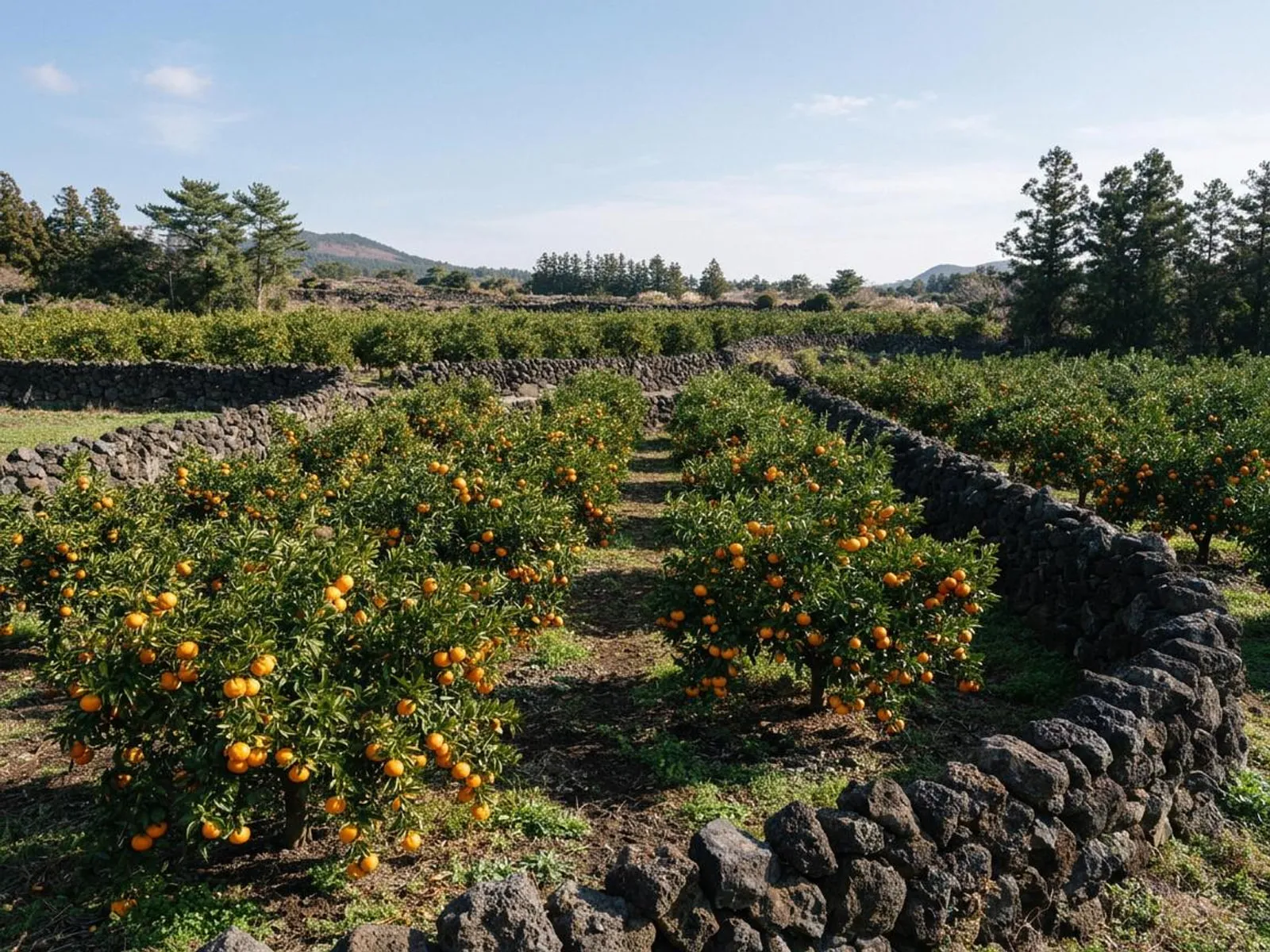
The provincial government describes Seogwipo as covering the southern part of Jeju Island, with outlying islands including Gapado and Marado under its jurisdiction. Agriculture, particularly citrus growing, plays an important role, and the city’s landscapes include coastal cliffs, waterfalls and volcanic formations. Like Jeju City, Seogwipo reports to the provincial government rather than operating as an independent local government, and it is divided into eup (towns), myeon (townships) and dong (neighborhoods). Jeju Special Self-Governing Province: administrative districts
The province gives a registered population of 664,792 for Jeju as a whole, covering both cities, as of 2025. Jeju Special Self-Governing Province: Jeju in numbers Its English pages do not give a separate figure for Seogwipo, and the Seogwipo City website could not be read for this guide, so no city population is given here.
Hallasan, at the center of the island, is part of the UNESCO World Natural Heritage property “Jeju Volcanic Island and Lava Tubes,” inscribed in 2007. Jeju Special Self-Governing Province: UNESCO
The table below is an editorial grouping for orientation, drawn from the official pages cited. It is not an official zoning.
| Area | What it is | Source |
|---|---|---|
| Central Seogwipo | The town center, with Seogwipo Maeil Olle Market, Lee Jung-seop Street and Jeongbang Falls, a waterfall that drops into the sea | Visit Jeju |
| Jungmun Tourist Complex | A resort area west of the center, across Jungmun-dong, Saekdal-dong and Daepo-dong, developed since 1978, with hotels, convention facilities, museums and Jungmun Saekdal Beach | Visit Jeju |
| Offshore islands | Gapado and Marado, off the south coast | Jeju Province |
| Southern slopes | The south side of Hallasan, crossed by the 1100 Road toward Jeju City | Visit Jeju |
Visit Jeju describes the 1100 Road as connecting the north and south of the island over Hallasan, ending at the Jungmun Tourist Complex, with central Seogwipo a short drive east. Visit Jeju: from Jeju City to Seogwipo Individual sights are not covered here.
Getting around
Buses are Jeju’s public transport. Visit Jeju describes red express buses, numbered in the 100s, linking the island’s four cardinal points; blue intercity and city buses; and green branch or village buses, which may run less often. Besides Jeju International Airport, it names four main transit hubs, including Jeju Bus Terminal in the north and Seogwipo Bus Terminal in the south. Visit Jeju: public transportation
The same page describes airport limousine buses with luggage space that run between the airport and Seogwipo with few stops. One route runs through the Jungmun Tourist Complex to central Seogwipo, and others end at Seogwipo Bus Terminal or in the town center. It recommends a transportation card such as T-money. Visit Jeju: public transportation The page notes that information is subject to change, so check current routes on the province’s real-time bus app or Visit Jeju before you travel.
The island’s airport, Jeju International Airport, is in Jeju City, on the north side of the island. Jeju Special Self-Governing Province: administrative districts If you plan to rent a car and drive, check licensing and rental conditions with the rental company and official sources before you travel.
Seasons and when to go
The provincial government notes that Seogwipo in the south has a higher annual average temperature than Jeju City in the north. Its 1991-2020 normals give Seogwipo an annual mean of 16.9°C and 1,989.6 millimeters of precipitation, against 16.2°C and 1,502.3 millimeters for Jeju City. Jeju Special Self-Governing Province: climate
The same page describes mild, changeable springs from March to May; hot, humid summers from June to August with heavier rain and occasional typhoons; autumns that cool gradually but can still bring typhoons and strong winds early on; and winters from December to February when northwesterly winds make it colder and windier, though the coast stays relatively mild and Hallasan may see snow. Jeju Special Self-Governing Province: climate
These are broad patterns, not a forecast. Spring and autumn tend to suit coastal walking. Summer is beach season around Jungmun but brings humidity and storm risk, so watch official weather warnings. In winter, the south coast is the milder side of the island, but conditions on the 1100 Road and Hallasan can be very different.
What kind of stay it suits
This section is editorial judgment rather than official guidance.
Most visitors arrive in Jeju City, so Seogwipo works best as the second base on a trip of five days or more. Splitting nights between the north and the south cuts down on long bus rides across the island and leaves room for weather days.
Within Seogwipo, the choice is mainly between central Seogwipo and Jungmun. A base in town keeps markets, restaurants and the bus terminal close. Jungmun puts the resort hotels and beach on the doorstep but is farther from everyday town life. Travelers without a car generally do better near a limousine or express bus stop.
For a short trip of two or three days, Seogwipo can also be a long day out from Jeju City rather than a base, though that leaves little time on the south coast itself.
Explore further
- South Korea: the country overview
Sources checked November 22, 2026. Population figures change, and bus routes, payment rules and airport services should be confirmed with the operators before travel. Climate figures are long-term averages, the area grouping is editorial, and the stay suggestions are editorial planning guidance.