Italy runs from the Alps and the broad Po Plain down a Mediterranean peninsula whose middle is shaped by the Apennines. Sicily and Sardinia are large regions in their own right, with separate connections, landscapes and histories. Rome is the capital. Milan, Turin, Venice, Bologna, Florence, Naples and Palermo show how much of the country’s political and economic history developed in places with strong identities of their own. Italia.it’s guide to the regions
It suits travelers who want to understand historic cities, landscapes and living local cultures, and people who like to build a week around a few places with good links between them. There is no requirement to start or finish in Rome. The north has major city gateways, and Naples or an island arrival can make better sense for a trip farther south. For the first visit, choose the distance you want to cover and the kind of place where you will spend most evenings.
Italy’s main urban rail corridors make some ambitious plans straightforward. They also make it easy to mistake an intercity service for full coverage of an area. A small hill town may have a station with its name far down the slope, and a place facing the same sea as a major port may require a separate transfer. For a month, a regular neighborhood with food, a workable apartment and a reliable connection can be more important than having a celebrated view.
Italy sits within Europe. The map shows the Alps, the Po Plain, the Apennines, the Adriatic and Tyrrhenian seas, Sicily and Sardinia, and the cities that anchor this overview.
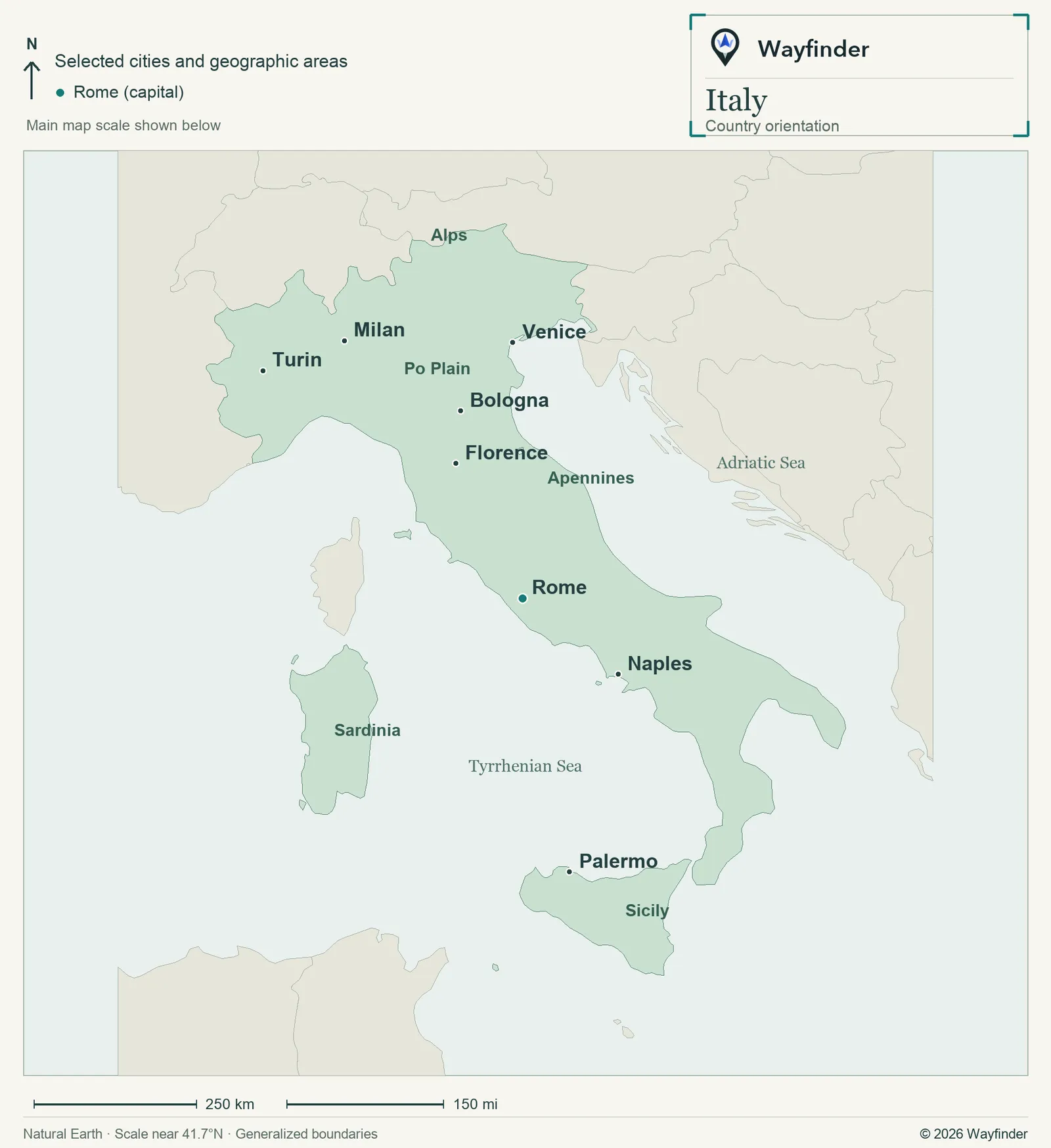
Open the full-detail orientation map

Regions and settlement
The groupings below are editorial. Italy’s official regions have their own names and boundaries, while tourism areas can be smaller or cross them. In particular, the Alps, Po Plain and Apennines describe landscapes, not levels of government. Italy’s tourism authority lists the regions individually. Italia.it’s regional directory
The northwest and the Po Plain. Milan and Turin can anchor a first northern visit with very different urban histories. Milan suits a stay centered on contemporary city life and links east or south. Turin provides a base for understanding the former Savoy capital and the continuing relationship between industry and urban form. If the Alps are the main focus, choose a valley first. The mountains are on the map near the cities, but a traveler who wants regular access to a specific valley should study its approach on a normal weekday.
The flat country to the south and east encourages movement between cities. It can also make them look more interchangeable than they are. Bologna is useful for a stay that mixes a walkable city routine with regional and intercity rail. The Po Plain can still feel very different depending on whether the setting is an industrial area, a metropolitan neighborhood or farmland. Choose an accommodation address by its everyday connections, particularly if you expect to use different stations or terminals.
The northeast and the Adriatic. Venice’s relationship to the lagoon places it in a geographic category of its own. Verona and other inland cities illustrate another part of the Veneto. Farther north, the Dolomites and valleys near the Alpine border have a different season and transport pattern. Veneto, Friuli Venezia Giulia and Trentino-Alto Adige/Südtirol are useful names to keep distinct when following tourism or administrative information. If the choice is between an urban base and mountain lodging, consider how much time you want outdoors each day and which part of the travel plan can move.
Central Italy. Florence is a city base in Tuscany, while the hill landscapes associated with Tuscany and neighboring Umbria ask different questions about travel. Rome is big enough to sustain a long stay on its own. The fact that both Florence and Rome are on the main rail corridor makes the transfer practical, but it does not make either a simple substitute for a rural apartment or kitchen-equipped place with easy parking. Central regions on the Adriatic side and away from the main spine also deserve their own plan.
The southern mainland. Naples and the Bay of Naples combine metropolitan life with a volcanic setting. Farther east, Puglia looks to the Adriatic. The interior of Basilicata and the far south of Calabria bring different schedules, distances and terrain. Do not organize the entire south as a string of outings from Naples. Give each distinct coast or inland cluster a base if the reasons for going merit the time. A traveler who needs an easy return every evening will ask different questions from someone with a flexible route and a car.
Sicily and Sardinia. Sicily sits immediately beyond the strait from Calabria, while Sardinia lies farther west across the Tyrrhenian Sea. Palermo gives a particular introduction to Sicily. Catania and the eastern side provide a different one. Sardinia also has multiple centers and coastlines, with Cagliari one possible city base. Treat transport to an island, transport within it and the reliability of the particular approach as three separate decisions. A week without a car is more plausible when the destination itself supports many of the days you want to spend there.
Istat counted 58,943,464 usual residents at the end of 2024. Its report records small increases in the northwest and northeast, alongside decreases in the center, south and islands. These are changes within broad statistical areas, which include both large cities and smaller communities. One of the most useful things a visitor can notice is the difference between the national picture and the place at street level. An attractive center with a substantial flow of visitors might have a very different population pattern from the surrounding residential or industrial areas. Istat 2024 population census
History through places
The prehistoric record takes the story well before Rome. The rock drawings of Valcamonica and Sardinia’s domestic and funerary landscapes show what can survive from different kinds of communities. The Etruscan necropolises at Cerveteri and Tarquinia preserve evidence of a culture whose geography overlapped parts of what became Roman Italy. Start by asking what kind of evidence a property offers. A burial landscape, a settlement and a work made for display tell different kinds of stories. UNESCO Italy list
Rome’s ancient structures and the Via Appia help connect the institutions of the city with a wider road and settlement network. Pompeii and the surrounding archaeological areas show a different scale of Roman life. Their importance rests in part on the way buildings, streets and domestic spaces survive. Later religious buildings and traditions in Rome and Ravenna are another layer. If you are comparing these places, keep a record of the period represented by the buildings and of the time when the modern city took shape around them. UNESCO Italy list
Venice, Genoa and Palermo offer three different histories of maritime exchange. Venice’s lagoon setting helps explain how the city made room for arched bridges, boats and waterfront approaches. Genoa’s Le Strade Nuove and Palazzi dei Rolli reflect elite housing and visiting arrangements in a maritime republic. Palermo’s Arab-Norman inscription recognizes buildings whose forms reflect exchange across cultural traditions. These are starting points for reading the country through ports rather than a definitive list of Italy’s maritime societies. UNESCO Italy list
Florence, Ferrara and Urbino show that the Renaissance was not concentrated in one city. Urban plans, courts, religious institutions and art patronage all shaped what survives. Turin’s Savoy residences give a different connection between urban development and political authority. The country’s modern political unity brought together places that had their own institutions and connections. That older geography is one reason a regional treatment is more informative than a route organized exclusively around national symbols. UNESCO Italy list
Ivrea is a useful modern counterpoint. Its World Heritage recognition concerns a twentieth-century industrial city associated with Olivetti, a reminder that Italy’s material heritage includes the housing, workplaces and public spaces of modern industries. Move between these phases of history mentally, even if you stay in one region. A busy train station, a twentieth-century residential area and a protected center give different views of how the same place functions. UNESCO Italy list
Climate and choosing dates
The national environmental institute ISPRA publishes 1991–2020 temperature and precipitation normals, using the national climate data system and additional records. Its monthly and seasonal maps let you compare the northern plain, high mountain areas, peninsular coasts and islands. The following comparison uses that spatial framework. Actual conditions depend on elevation, exposure and what the weather is doing on your day. ISPRA climate normals
| Area | Cooler season | Warmer season | Planning consequence |
|---|---|---|---|
| Alps and Dolomites | Cold and snow at higher elevations | Valley warmth and cooler high places can occur on the same day | Compare the village and the elevation you expect to reach |
| Po Plain | Cool winters, distinct from Mediterranean coasts | Hot conditions are possible in lowland cities | Ask about ventilation and keep a flexible middle of the day |
| Central peninsula | Valley, coast and mountain conditions differ | Warm to hot conditions, especially away from high ground | Choose a local normal for the actual city rather than using Rome for rural Tuscany |
| Southern coasts | Generally milder lowlands, with cool uplands | Heat can matter inland and on exposed coasts | Compare shade and evening transport before choosing a base |
| Sicily and Sardinia | Coastal conditions differ from higher interiors | Heat and wind can alter the comfort of a coastal stay | Check the exact part of the island and current marine conditions |
The right month depends on which part of the country supplies the reason for going. For a trip spanning Rome and a valley in the Alps, compare the two sets of conditions before buying tickets. A week built around city neighborhoods can be arranged to avoid the warmest hours. A month in a small coastal town gains or loses much of its appeal depending on whether everyday services work when you intend to go. Local openings and transit need separate checks from weather.
Check weather with an itinerary in mind. If the principal outdoor day has to happen at one end of the week, choose an alternative nearby. If your stay relies on a ferry, avoid treating a change in sea conditions as a small delay in an otherwise fixed plan. Look at whether you can reach the room in rain, sit somewhere comfortable in daytime heat and adjust the ordinary rhythm without making a new booking.
Economy and everyday infrastructure
Istat’s annual national accounts estimate that real GDP grew 0.6% in 2025. The release separates agriculture, industry, construction and services and reports real increases in each broad category. The figure measures a completed year and incorporates statistical revisions. It is evidence about the size and changing output of the economy, distinct from a projection for a later year or an index of the prices a traveler will pay. Istat annual national accounts
Italy’s heritage and tourism are conspicuous but leave a great deal of the economy out of view. The regions around Milan, Turin and the Po Plain sit within a large urban network. Government and other services are also visible in Rome, while ports such as Genoa and Naples connect working cities to wider systems of trade and movement. Rural and agricultural areas are economically active places even where a visitor sees little of the activity. An old landscape can participate in a modern supply chain.
The practical infrastructure test differs by length of stay. On a week-long visit, a station, place to get breakfast and an easy return to the room may be enough to make a city a good fit. For four weeks, check whether you can use the local supermarket and pharmacy, how you will do laundry and whether the apartment works during the part of the day you expect to spend inside. A center with narrow streets can require different arrangements for luggage delivery or curbside pickup from a building across a wide avenue.
If you are choosing a smaller town, run a weekday and Sunday scenario. Ask about the walk from the accommodation to the useful stop, whether the route involves stairs and whether there is a backup during rain. A stop served by a suitable connection at one time can be much less useful for a week of late returns. Confirm practical things with the provider instead of assuming a location described as central will meet them.
Language culture and etiquette
Italian gives visitors the broadest starting point for communication. Italy also contains regional and minority languages. Use the local name that matches the service or address. Knowing that Florence appears as Firenze, for example, can prevent a practical misunderstanding when looking at the next departure. Italia.it practical information
English can be easier to arrange through international hotels and other tourist-facing providers than in ordinary transactions. Confirm the language for a clinic, a building repair, a lease or a government form with the person actually providing the service. For consequential documents, arrange competent language support. For routine errands, learn simple greetings and a way to ask someone to slow down. Keep actual addresses and stop names offline and in Italian where useful.
Etiquette works best when you read the setting. At a religious service, follow local notices and give worshippers room. In a residential lane, ask before photographing people and keep enough space for doors and stairs to be used. Ask how a cafe handles ordering and whether the quoted choices refer to sitting at a table or taking something away. Service conventions can vary by establishment. Paying attention in the moment works better than assuming there is one rule for the whole country.
Local food is one way to understand regional identity without turning other people’s daily life into an exhibit. If an ingredient matters to your health or beliefs, prepare the relevant question in Italian and confirm the answer with the kitchen. Ask what the menu description covers. Expect an ordinary place serving residents to have its own schedule, and check what is available around the time when your train arrives.
Budget and payments
The euro is the currency. Take a backup payment method and check acceptance where the purchase matters. For a longer rental, ask for written amounts for the reservation, final payment and any deposit, and check how each is collected and refunded. Separate the amount you will spend from the amount tied up temporarily. Foreign-card charges are a question for the issuer as well as the shop. Italia.it practical information
This is an illustrative budget dated November 21, 2026 for one adult with a private room or apartment, everyday meals and local transport. It uses invented inputs, not market averages or current offers. It compares seven paid nights with a separate 28-night agreement.
| Item | Seven nights | Twenty-eight nights |
|---|---|---|
| Accommodation at €105 per night or a separate €1,650 monthly quote | €735 | €1,650 |
| Food and household costs at €34 or €23 a day | €238 | €644 |
| Local transport at €8 or €6 a day | €56 | €168 |
| Incidental spending | €75 | €180 |
| Illustrative total | €1,104 | €2,642 |
Exclude intercity travel, flights, admissions, insurance and any refundable security deposit from that subtotal and add your real quotes separately. Check which charges must be paid to the property or are added at checkout. Apartment costs can look favorable if a traveler will use the kitchen. The comparison changes if the place is hard to reach with groceries or if the quoted unit is too small to use comfortably on a rest day.
Arrival and internal transport
Arrive near the part of Italy that justifies most of the time. A northern city and a southern island can both make sense on one long trip, but a return to the same airport may take useful days away from each. Compare a trip ending elsewhere with a round trip and an internal transfer. Check the onward station or port and factor in the time you can spend moving after a long flight. For entry, the Italian Embassy in Washington publishes visa guidance and a list of consular offices by area. For a U.S. passport and proposed trip, consult the Italian office serving your residence for the applicable conditions, as checked November 21, 2026. Italian Embassy visa information
| Example | Comparing the options | The detail that decides |
|---|---|---|
| Milan to Rome or Naples | A high-speed train and a flight | Count hotel to station or airport and the time to the next accommodation |
| Florence and a base in the Tuscan hills | Stay in town for urban days or use a car for a separate rural portion | Check the exact hill town, road access and parking before assuming either mode works |
| Venice and an Alpine valley | Use a rail corridor where it fits, then compare the final road leg | Do not book an upland room until you know how its access works in the intended season |
| Mainland to Sicily or Sardinia | Compare flight and ferry itineraries serving the intended end of the island | Count arriving with or without a vehicle, port transfers and schedule flexibility |
Trenitalia’s Frecciarossa information describes the high-speed network and its main destinations. Look up the exact route with the operator before booking. A ticket to a major destination can still leave a substantial ride to a rented apartment, and an outlying station may serve an otherwise convenient route. For an island or rural move, do the same test in reverse. Confirm that the onward operator uses the port or station at which you actually arrive. Trenitalia Frecciarossa
Safety health and access
The UK Foreign, Commonwealth & Development Office advice for British travelers was checked November 21, 2026. Its safety section treats public-place theft, mountain activities and natural hazards separately. A trip through major stations or crowds needs practical attention to belongings. In the Alps the weather and avalanche information matter to travelers exposed to those conditions. In volcanic or earthquake-prone areas, consult local official notices for the exact place and date. Use the advice applicable to your own nationality as well. FCDO safety and security
For British travelers, use the FCDO health page to check current guidance for access to treatment and cover, and confirm how that information applies to the facility and itinerary. A U.S. traveler should obtain destination-specific consular and coverage information for their own circumstances. Plan a route to care for each base where a medical issue would be difficult to manage. In a mountain valley or on an island, the hospital or pharmacy you need may not be near accommodations even when a tourist information office is. FCDO health guidance
Check access at the level of the whole trip. Conditions for a usable rail platform, a step-free route to a city room and a particular entrance at an archaeological site are distinct. If stairs or heat would constrain the day, ask for enough detail to choose a shorter route and prepare a fallback. Do not treat a destination description as a guarantee about the condition of a particular lift, pedestrian lane or seasonal transfer.
Heritage and nature
The official UNESCO list for Italy includes shared properties and sites represented by several named components. The Dolomites, Mount Etna and the Aeolian Islands demonstrate how different the natural entries are in character. The historic centers and cultural landscapes are equally diverse. Being inscribed does not confer a uniform opening or access regime. Check the managing authority once a specific property and date matter to your trip. UNESCO World Heritage list for Italy
- Sacri Monti of Piedmont and Lombardy (2003)
- 18th-Century Royal Palace at Caserta with the Park, the Aqueduct of Vanvitelli, and the San Leucio Complex (1997)
- Arab-Norman Palermo and the Cathedral Churches of Cefalú and Monreale (2015)
- Archaeological Area and the Patriarchal Basilica of Aquileia (1998)
- Archaeological Area of Agrigento (1997)
- Archaeological Areas of Pompei, Herculaneum and Torre Annunziata (1997)
- Assisi, the Basilica of San Francesco and Other Franciscan Sites (2000)
- Botanical Garden (Orto Botanico), Padua (1997)
- Castel del Monte (1996)
- Cathedral, Torre Civica and Piazza Grande, Modena (1997)
- Church and Dominican Convent of Santa Maria delle Grazie with “The Last Supper” by Leonardo da Vinci (1980)
- Cilento and Vallo di Diano National Park with the Archeological Sites of Paestum and Velia, and the Certosa di Padula (1998)
- City of Verona (2000)
- City of Vicenza and the Palladian Villas of the Veneto (1994, 1996)
- Costiera Amalfitana (1997)
- Crespi d’Adda (1995)
- Early Christian Monuments of Ravenna (1996)
- Etruscan Necropolises of Cerveteri and Tarquinia (2004)
- Ferrara, City of the Renaissance, and its Po Delta (1995, 1999)
- Funerary Tradition in the Prehistory of Sardinia – The domus de janas (2025)
- Genoa: Le Strade Nuove and the system of the Palazzi dei Rolli (2006)
- Historic Centre of Florence (1982)
- Historic Centre of Naples (1995)
- Historic Centre of Rome, the Properties of the Holy See in that City Enjoying Extraterritorial Rights and San Paolo Fuori le Mura (1980, 1990)
- Historic Centre of San Gimignano (1990)
- Historic Centre of Siena (1995)
- Historic Centre of the City of Pienza (1996)
- Historic Centre of Urbino (1998)
- Ivrea, industrial city of the 20th century (2018)
- Late Baroque Towns of the Val di Noto (South-Eastern Sicily) (2002)
- Le Colline del Prosecco di Conegliano e Valdobbiadene (2019)
- Longobards in Italy. Places of the Power (568-774 A.D.) (2011)
- Mantua and Sabbioneta (2008)
- Medici Villas and Gardens in Tuscany (2013)
- Padua’s fourteenth-century fresco cycles (2021)
- Piazza del Duomo, Pisa (1987)
- Portovenere, Cinque Terre, and the Islands (Palmaria, Tino and Tinetto) (1997)
- Prehistoric Pile Dwellings around the Alps (2011)
- Residences of the Royal House of Savoy (1997)
- Rhaetian Railway in the Albula / Bernina Landscapes (2008)
- Rock Drawings in Valcamonica (1979)
- Su Nuraxi di Barumini (1997)
- Syracuse and the Rocky Necropolis of Pantalica (2005)
- The Trulli of Alberobello (1996)
- The Great Spa Towns of Europe (2021)
- The Porticoes of Bologna (2021)
- The Sassi and the Park of the Rupestrian Churches of Matera (1993)
- The system of Italian-style condominio theatres of the 18th and 19th centuries in Central Italy (2026)
- Val d’Orcia (2004)
- Venetian Works of Defence between the 16th and 17th Centuries: Stato da Terra – Western Stato da Mar (2017)
- Venice and its Lagoon (1987)
- Via Appia. Regina Viarum (2024)
- Villa Adriana (Tivoli) (1999)
- Villa d’Este, Tivoli (2001)
- Villa Romana del Casale (1997)
- Vineyard Landscape of Piedmont: Langhe-Roero and Monferrato (2014)
- Ancient and Primeval Beech Forests of the Carpathians and Other Regions of Europe (2007, 2011, 2017, 2021)
- Evaporitic Karst and Caves of Northern Apennines (2023)
- Isole Eolie (Aeolian Islands) (2000)
- Monte San Giorgio (2003, 2010)
- Mount Etna (2013)
- The Dolomites (2009)
Choose a base for a week or a month
| Base | An ordinary week | An ordinary month | Check first |
|---|---|---|---|
| Rome | Spend most of the week understanding one large city and a few districts | Favor a residential area with simple everyday shopping and reliable links to the districts you expect to revisit | Morning and evening route to the accommodation, stairs and cooling |
| Bologna | Stay in one city and test a few walks around separate neighborhoods | Use a local rhythm with occasional train journeys | Noise, local errands and the actual path to the station |
| Florence | Focus on the city with one nearby contrast | Compare central living with a quieter location that remains well connected | Walking gradients, indoor space and household supplies |
| Naples | Use the city to understand the bay and handle separate excursions without changing rooms | Choose a neighborhood whose street conditions and uphill or downhill journeys suit you | Late returns and distance to the useful station |
| Palermo | Explore an island city at a settled pace | Judge whether your recurring needs are satisfied locally before extending to other parts of Sicily | Grocery access, summer room conditions and transport beyond the center |
Several nights suit one city and one focused line of inquiry. Around a week, pick one base with an occasional outing or two places on a route you have verified. Two weeks can support a mainland and island combination or two city regions and a landscape break. Think about what a transfer removes from either end of the day. A six-hour move consumes more than six hours if it also means arranging luggage early and reaching the next room late.
For slow travel, choose an ordinary weekly routine as the test. A room should serve you on a day when you cook, read and take a short walk as well as on the day you come back from a celebrated place. Leave part of the week open and pay attention to when the neighborhood is active. Try the routes you would use in the morning and the evening. If a longer stay depends on a familiar hobby or regular appointment, ask how to arrange it before committing to the accommodation.
Three different northern stays
Start with the geography between Turin, Milan and Bologna. Turin works for a week spent mainly in one city, with selected journeys closer to the western Alps. If you chiefly want to see how cities and foothills relate, use two practical bases instead of racing along the whole northern plain. A plan built around Bologna can serve a city-centered stay and include a few outings farther east. The weather and the urban routine may matter more than differences in the headline rail journey. Ask how many times you would actually leave each city in a month.
An Alpine stay organized around Tirano raises another question. The northern rail setting is part of the appeal, but high country, lakes and towns to the south are different geographic commitments. For an extended stay, compare housing in Tirano with a location farther down the valley. Pick the place where you expect to spend the most unstructured time. A railway transfer point is useful if you need to transfer often. If the journeys are infrequent, room comfort and the daily walk to the supermarket deserve more weight.
Venice presents a different kind of location decision. Establish what it means for a room to be within reach of a station or boat stop. Consider the repeated effort of carrying bags over bridges or through busy lanes, including on arrival and checkout. A mainland stay and one in the historic city offer different rhythms. For a visit organized around the lagoon and the city, the location can change when you see ordinary streets as well as how you arrive. If Venice is one of several regional rail trips, take the extra journeys into account before deciding.
Divide the south by connections
A Naples week can make the relationship between the city and the Bay of Naples easier to understand. If you also want to spend time in Puglia or Basilicata, price a separate move instead of judging the distance by the outline of the country. The southern mainland is not one connected urban area. Put nights where the evening and following morning will be worth having. In Sicily, the same principle applies between Palermo and the east. A train or road journey that appears straightforward for one outing may become the dominant cost in time if you repeat it. On a month-long island stay, start with a town that has what you need on a regular day, then decide whether excursions justify a car for part of the time.
Longer stays and retirement
A month in Italy can clarify what climate and kind of neighborhood you would choose. A visitor and a resident face different immigration, healthcare and administrative questions. U.S. passport holders considering residence should use their Italian consular office to check the categories and current evidence required for their intended purpose. Keep permission to stay separate from health coverage and tax status. Italian Embassy visa information · RESTED’s longer-stay preparation guide
Explore the existing Global Guide visitor guides
North
- Turin visitor guide
- Milan visitor guide
- Tirano’s basilica and Palazzo Salis
- Venice visitor guide
- Verona visitor guide
- Bologna visitor guide
Center
South and islands
For things to do, browse Bucketlist Experiences.
Official sources checked November 21, 2026.
Explore within Italy
Map of Italy
Hold Ctrl (or ⌘) and scroll to zoom, or use + and −
Pins mark the town or main visitor area of each place and are approximate.